

ING Sustainable Finance Pulse - issue 11
Reading time: 6min
9 September 2026
Welcome to ING’s Sustainable Finance Pulse - a quarterly glimpse into the world of sustainable finance and ING’s take on it.
In this issue:
- 1.0 Growth on the horizon
- 2.0 Solid Q2 for ING
- 3.0 Adaptation an emerging business priority
- 4.0 Financing adaptation
- 5.0 Research: The business case hiding in avoided losses
Resilient issuance keeps the global sustainable debt market on track for growth in 2026, despite geopolitical uncertainty, policy shifts and pockets of saturation. ING Research believes sustainable finance issuance will remain resilient.
ING sees a positive quarter in sustainable finance activities.
This SF Pulse also highlights the topic of climate adaptation and resilience and how ING helps clients by combining financing, advice and sector insight.
1.0 Growth on the horizon for global sustainable finance in 2026
At the halfway mark of the year, we still expect the global sustainable finance market to return to growth for the full year, surpassing 2025 levels after a modest decline in 2025 from 2024.
Global sustainable debt issuance (excluding asset-backed securities, or ABS) totalled $846bn in the first half of 2026. Although this is a bit lower than the first-half issuances in 2025, it remains comfortably within the healthy $800bn-900bn range recorded in the first halves since 2022. That shows considerable market resilience, especially given the ongoing Middle East tensions and subdued sustainability policy environment in the US.

Looking at the full year of 2026, we expect resilience to yield growth, with the global sustainable finance market reaching $1,621bn of issuance. This will be driven by many factors:
- Middle East tensions make a stronger case for enhanced energy security, affordability, and industrial competitiveness in Europe through clean energy buildout.
- The rush to build AI-driven data centres – and the growing scrutiny of their sustainability – is expected to drive sustainable debt issuance in the sector globally.
- The consequent need to enhance digital and power infrastructure to support AI development and electrification will spur sustainable financing.
- Many corporates remain committed to decarbonisation and managing climate risk.
- Governments are further leveraging sustainable finance as a tool to fund decarbonisation efforts.
- Regulation and standardisation provide more clarity.
EMEA is leading sustainable debt issuance in 2026. Issuance in both the first and second quarters exceeded 2025 levels, driving a strong first half of the year. Much of this growth came from the public sector, with government agencies, sovereigns, and supranationals issuing a record $245bn in the first half – 50% higher than in 2025. Financial institutions also contributed to the momentum, increasing issuance by 36% year-over-year (YoY).
In APAC, issuance levels have been mostly steady over the past five years, despite first-half 2026 volumes being slightly lower than in 2025. That small dip is mainly due to softer issuance from financial institutions following a record first half in 2025. Even so, APAC is well positioned for growth, with both governments and companies continuing to advance decarbonisation goals through sustainable financing.
In the US, policy uncertainty continues to weigh on sustainable financing. First-half 2026 issuance was about 40% lower than in both 2024 and 2025, although it remained slightly above 2020 levels. Data centres, renewable energy, and related infrastructure have emerged as the engine of sustainable financing. We expect these sectors to maintain momentum through 2026 and 2027. For data centres, however, growing scrutiny of community impacts could lead to more selective, but ultimately higher-quality, sustainable debt issuance.
We stand by the forecasts for the year as per the table below, as we already see most segments beyond the halfway point in terms of reaching these targets. The public market side, in particular, has 55-60% of the forecast already issued. While the private market side appears to be lagging, we note that there may be some under-reporting within the private market side, and these figures may not reflect full issuance levels.
Read more on Global Sustainable debt issuance in our recent report Opens in a new tabGlobal sustainable finance 2026: growth on the horizon.
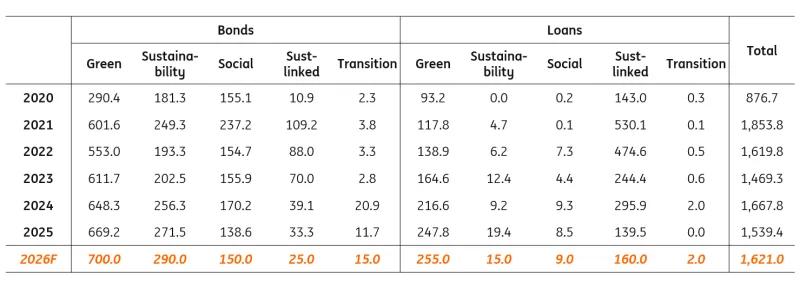
Global sustainable finance issuance by number (excluding ABS)
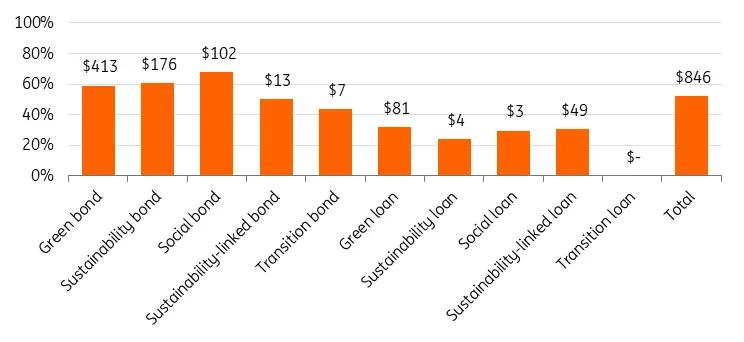
Global sustainable issuance in the first half of 2026 as a % of full-year forecast
2.0 Strong Q2 drives record H1 performance

ING delivered its strongest first half on record, mobilising* €86.5bn of sustainable finance in H1 2026, a 29% increase compared to H1 2025. This was supported by a particularly strong second quarter, in which ING mobilised €53.7bn, up 46% versus Q2 2025.
Transaction activity also accelerated, with 129 deals completed across the four products shown, compared with 116 in Q2 2025 and 78 in Q1 2026.
Sustainability-linked loans (SLLs) remained the largest contributor to Q2 mobilised volumes, followed by green loans and green bonds, together accounting for 83% of sustainable finance mobilised during the quarter.
Performance was supported by an active green bond market, continued growth in green lending and a strong rebound in SLL activity, highlighting ongoing resilience of SLLs, which remains a core client engagement tool for ING. The quarter also saw the return of sustainability-linked bond issuance, although we expect SLB markets to remain more selective and credibility-driven, with volume remaining modest.
*For more information and a full list of products please see: Opens in a new tabPerformance and reporting | ING
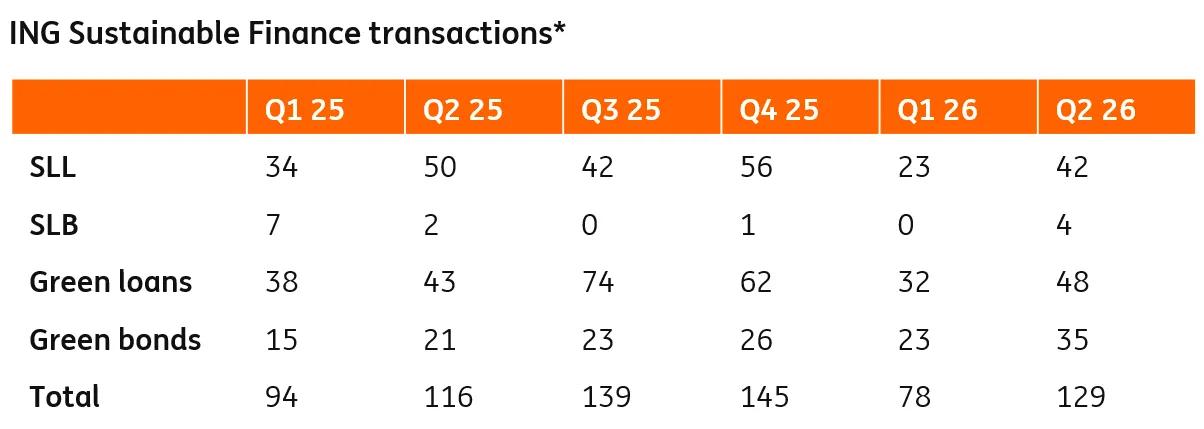
*Nr. of sustainable finance transactions of 4 most common sustainability products chosen by our clients
The EMEA region led in Q2 with 52% of mobilised volume, followed by the Americas (36%) and APAC (8%).
In Q2, the growth came from EMEA and US, with APAC stable. Americas was a key driver, despite market and political backdrop, with strong SLL and green loan activity across corporate, datacentre and renewable sectors. EMEA remains our largest and most mature market, where we continue to see a shift to quality. APAC outlook remains positive, with good traction across sustainable finance products.
Resilience and adaptation have become an increased area of focus for lenders and investors and have moved back up the client agenda. We expect to see these themes increasingly addressed in sustainable finance markets.
Despite geopolitical uncertainty and shifting climate policy, many organisations continue to view sustainability as a strategic priority. We remain dedicated to helping finance these investments, scale new technologies and the value chains around them, and mobilise the capital needed to turn innovation into viable, global solutions.

Peter Kindt
Global Head of Sustainable Solutions Group
“Sustainable finance is entering a new phase of growth. The market may be evolving, but the need to finance the energy transition, strengthen infrastructure, support innovation and build resilience to a changing climate remains as strong as ever.”
3.0 Climate adaptation: an emerging business priority
This summer’s heatwaves across Europe have shown how quickly physical climate risks can affect the economy. Energy systems came under pressure, transport and logistics networks were disrupted, and businesses faced growing challenges around infrastructure, water availability and supply chains. As extreme weather becomes more frequent, climate adaptation is beginning to move from a future concern to a more immediate business consideration, although many companies are still at an early stage of exploring what it means for them.
Decarbonisation remains essential, but some companies are starting to look at how to prepare their assets and operations for the physical consequences of climate change. For energy providers, that can mean strengthening electricity grids and improving the resilience of an increasingly electrified system. Some real estate companies are considering how buildings can better withstand heat stress and extreme weather, while transport, logistics and utility operators may need to assess how to keep critical networks running. In food and agriculture, water management, sustainable land use and climate-smart production practices are emerging as increasingly relevant issues across the value chain.
The investment needs are significant. Water infrastructure, flood protection, resilient energy and transport networks, and climate-smart technologies will all require capital. ING with support of consultancy Blunomy has estimated that the total financing needs for climate adaptation are around 1.2 trillion euro per year by 2035 globally.
According to a recent study from the Opens in a new tabEuropean Commission, the EU needs to invest €70 billion per year in climate adaptation up to 2050. Sustainable finance can help channel funding towards these areas, while providing companies with the flexibility to combine adaptation measures with their wider transition plans.
Financial institutions have an important role to play by bringing together financing, sector knowledge and strategic insight. As awareness develops, this can help clients begin to understand their exposure, explore practical investments and consider how resilience could be built into long-term decision-making.
Arash Mojabi, UK Head of Sustainable Solutions Group at ING, says:
Climate adaptation is still a relatively new consideration for many businesses. While some clients are beginning to look beyond immediate risks and ask how they can protect assets, strengthen supply chains and maintain competitiveness over the long term, others are only starting to assess what physical climate risks could mean for their operations. Sustainable finance can support that journey by helping turn credible resilience plans into investable solutions, alongside the continued transition to a low-carbon economy.
Adaptation and transition increasingly go hand in hand. As more companies begin to factor resilience into investment decisions, they can strengthen their ability to navigate a changing climate and capture the opportunities created by the shift towards a more resilient, low-carbon economy.
4.0 Financing adaptation
- ING was ESG Coordinator for Anglian Water's EUR 700m green bond - issued under their Opens in a new tabOpens a pdfSustainable Finance framework, which includes adaptation projects and will support their GBP 11bn investment programme from 2025-30.
- ING was the Sole Sustainability Structurer in the Hungarian Development Bank’s Opens in a new tabSustainable Finance Framework. That includes a dedicated Climate Change Adaptation category which relates to modernization, maintenance and operation of existing road infrastructure projects – aligned with the Substantial Contribution Criteria of the relevant economic activity in the EU Taxonomy.
- ING was also a Joint Sustainability Structurer for the Opens in a new tabState of Hessen’s Third Green Bond (EUR 1.5 billion) – this includes the 2025 Green Bond Framework and includes projects with adaptation elements.
5.0 ING Research: on adaptation: the business case hiding in avoided losses

Europe is already experiencing warming once associated with the distant future. The continent has warmed by around 2.5°C since pre-industrial times, roughly twice the global rate and already beyond the climate goal. The economic consequences of extreme weather were evident again this summer: heatwaves disrupted schools, hospitals and railways; drought constrained river transport and agricultural output; and wildfires damaged land and infrastructure.
Major insurers estimate that global losses from natural disasters amount to $280 billion a year, with only half being insured. There are no authoritative estimates of the adaptation spending required under different climate scenarios. The latest United Nations Adaptation Gap Report estimates that developing countries alone require $365 billion a year. Including developed countries would substantially increase the figure.
For businesses, adaptation is no longer about preparing for a one-off disruption. It is about operating in a new climate reality. Companies with energy- or food-intensive operations, physical assets in exposed locations or long, concentrated supply chains face the greatest risks. Their response should focus on three areas:
- Protect assets through flood and fire defences, heat-resilient buildings and nature-based solutions such as wetland restoration.
- Protect operations through energy and water efficiency, cooling systems, heat action plans and adjusted working hours.
- Protect value chains by diversifying suppliers and sourcing regions, and by holding strategic inventories.
Corporate action still lags behind awareness. Historically, less than 10% of climate finance has supported adaptation, while most funding targets emissions reduction. Surveys likewise show that many business leaders assess physical climate risks, but far fewer convert them into quantified investments. Economics helps explain the gap. Mitigation measures such as solar panels can generate revenue or cut costs—and hotter, sunnier conditions may strengthen their business case. Flood barriers, by contrast, generate no income; their return is the damage they prevent. Avoided losses are therefore harder to value, compare and communicate.
Adaptation also extends beyond individual companies. Resilient infrastructure, water, energy and food systems require coordination across business, government and finance.
Recent extremes have raised awareness. The priority now is credible plans, investment and collaboration—before another summer reveals the cost of delay.
For more information, please contact Gerben Hieminga, ING Research.
ING & Climate
Society is transitioning to a low-carbon economy. So are our clients, and so is ING. We finance a lot of sustainable activities, but we still finance more that’s not. See how we’re progressing on Opens in a new tabour climate approach.
Read more on this topic:

From transition to resilience: why climate adaptation is becoming a business priority
Climate change is already reshaping the way businesses operate. As physical climate risks become more visible, companies are increasingly exploring how to strengthen resilience alongside the transition to a low-carbon economy.
From transition to resilience: why climate adaptation is becoming a business priorityAuthors

Mayke Geradts
Sustainable Solutions Group - Food & Agri Lead
Peter Kindt
Global Head Sustainable Solutions Group a.i. / Head Transition Accelerator

Arash Mojabi
UK Head Sustainable Solutions Group

Gerben Hieminga
Sector economist Energy, ING Research

Astrid Overeem
Editor, Global PR Manager Wholesale Banking

Timothy Rahill
ING Research