

From experimental to expected: stablecoins, tokenised deposits and the rise of programmable liquidity in treasury
Reading time: 16min
19 November 2026
Corporate treasury has spent the last two decades digitising processes, improving visibility and centralising control. Yet despite significant advances in treasury management systems, API connectivity and payment infrastructure, one fundamental challenge remains: ensuring that liquidity is available in the right place, at the right time and under the right controls.
1. The treasury challenge
Corporate treasury has spent the last two decades digitising processes, improving visibility and centralising control. Yet despite significant advances in treasury management systems, API connectivity and payment infrastructure, one fundamental challenge remains: ensuring that liquidity is available in the right place, at the right time and under the right controls.
Could stablecoins and tokenised deposits offer new possibilities?
As part of the annual IFZ Financing and Treasury Study by Lucerne University of Applied Sciences and Arts (HSLU), ING was invited to share its perspective on the evolving role of digital money in corporate treasury, exploring where these innovations could create practical value and how they might complement existing banking solutions.
For multinationals, liquidity is dispersed across legal entities, currencies, jurisdictions, time zones, banking partners and settlement systems. Growth through mergers and acquisitions often adds further fragmentation. Treasury teams routinely manage multiple cash-management banks, local collection accounts, intercompany funding structures, foreign exchange exposures and collateral requirements. The challenge is not simply moving money faster, but maintaining visibility, control and efficient access to liquidity across increasingly complex macroeconomic environments. At its core, the challenge of liquidity management is shapedby five interrelated factors that treasury teams must continuously balance (see Figure 1):
- Cash visibility across entities and banks
- Liquidity concentration and intercompany funding
- FX, collateral and margin requirements
- Settlement timing, cut-off times and local restrictions
- Counterparty exposure and diversification of banking risk
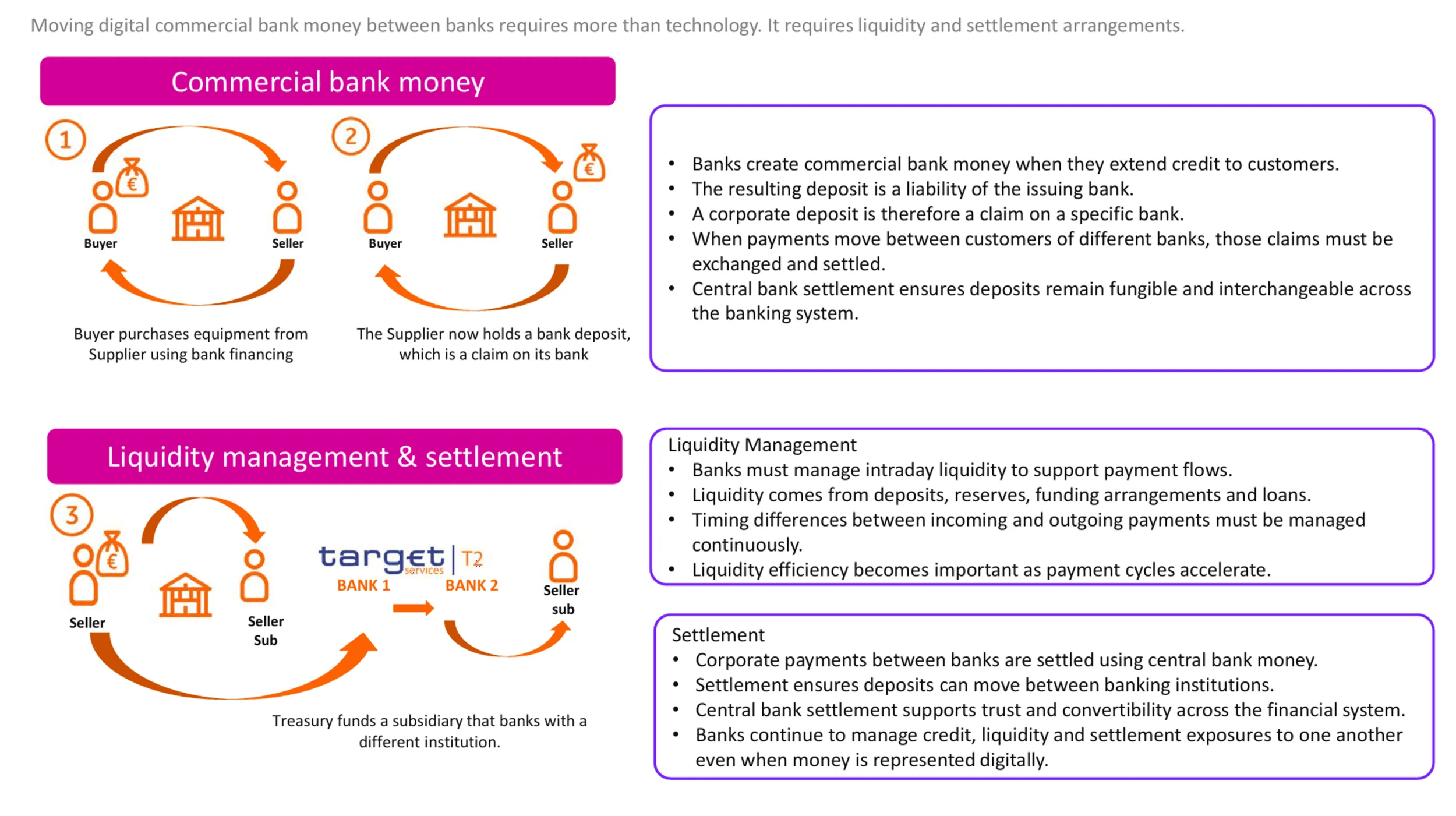
Figure 1: Setting the scene | Digital money still depends on banks, liquidity, settlement and trust.
Treasury’s challenge is not about moving money faster. It is ensuring liquidity is available in the right place, at the right time and under the right controls.
This explains why the discussion around digital money and digital assets is evolving. For years, the focus was largely on
cryptocurrencies as alternative assets. Today, attention has shifted to regulated forms of digital money such as stablecoins and tokenised deposits, together with the growing tokenisation of financial assets. The significance of these developments is not the creation of a new asset class. Rather, they introduce new infrastructure in which liquidity, assets and settlement can interact more seamlessly. When both money and assets exist in digital form, treasury processes such as collateral management, liquidity mobilisation and settlement can become increasingly automated, conditional and synchronised.
The question is no longer whether these technologies exist. The morerelevant question for treasury is where they solve genuine treasury challenges and address the foundation of trust.
2. The foundation of trust
Before exploring new forms of money, it is worth understanding why today’s system works and what makes today’s money a trusted means of payment. Commercial bank money is created when banks extend credit and record deposits as liabilities on their balance sheet. Because a deposit is a claim on a specific bank, payments between customers of different banks require those bank liabilities to be exchanged and settled. Central bank settlement provides the anchor that makes commercial bank money exchangeable across banks. For acorporate treasurer, the value of commercial bank money extends far beyond the payment itself. It is embedded within established legal frameworks, prudential supervision, liquidity management, settlement arrangements, governance, credit relationships and treasury systems. Together, these components support trust and broad acceptance. Understanding this ecosystem is important because any new form of money must ultimately deliver not only technological innovation but also the same level of reliability and confidence in the solution that they bring.
3. Stablecoins and tokenised deposits: similar technologies, different solutions
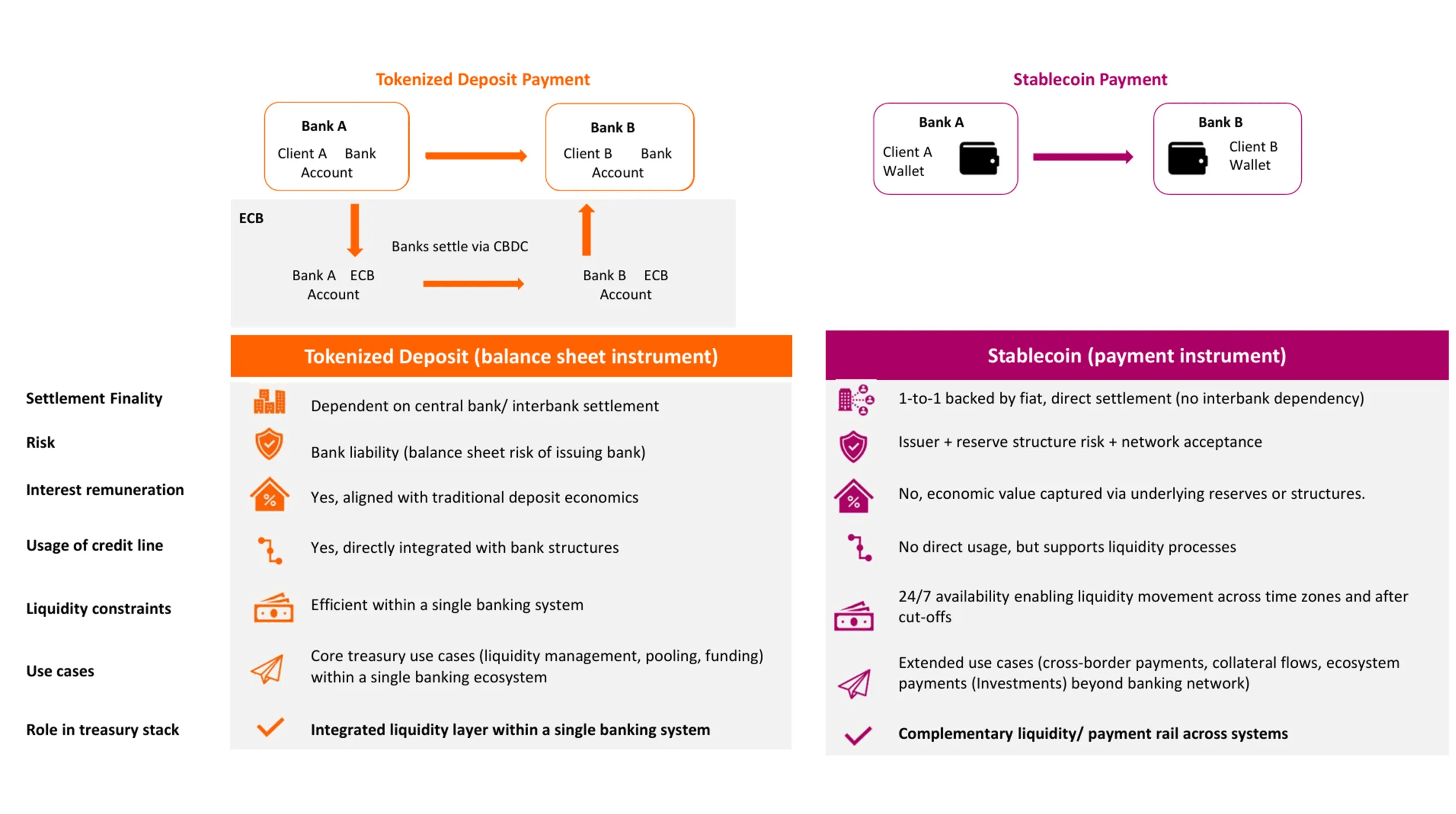
Stablecoins and tokenised deposits are often discussed together, but they address different needs. A stablecoin is fiatbacked and typically designed as a transferable settlement instrument, backed one-to-one by reserve assets and capable of moving as a digital form of cash from payer to payee across participants and networks. A tokenised deposit, by contrast, remains commercial bank money: a liability of the issuing bank, integrated within its banking network and familiar to corporate governance and treasury structures. This distinction matters (see Figure 2).
Figure 2: Tokenized deposit vs stablecoin | For treasurers, the differentiator is not the technology, but the liquidity network in which it can be used and settled.
Stablecoins can potentially support value transfer between participants that do not share the same banking network. Tokenised deposits are currently particularly useful for liquidity movement, settlement and treasury activities within a bank’s network or connected banking environment. Over time, their applicability may expand as interoperability and interbank settlement arrangements mature. Scaling tokenised de posits across banks currently requires the broader commercial bank money value chain to work together, including interoperability and an arrangement for interbank settlement. While this challenge has not yet been fully resolved, multiple industry initiatives are actively exploring solutions that could allow tokenised deposits to be exchanged more seamlessly across banking networks in the future.
Stablecoins and tokenised deposits are not primarily a new asset class. They are new infrastructure for moving and managing liquidity.
As a result, these instruments are more likely to coexist than directly compete. Different forms of digital money may serve different treasury use cases depending on the currency, corridor, counterparty and liquidity requirements involved. One thing is clear the infrastructure is evolving.
4. Market infrastructure is taking shape
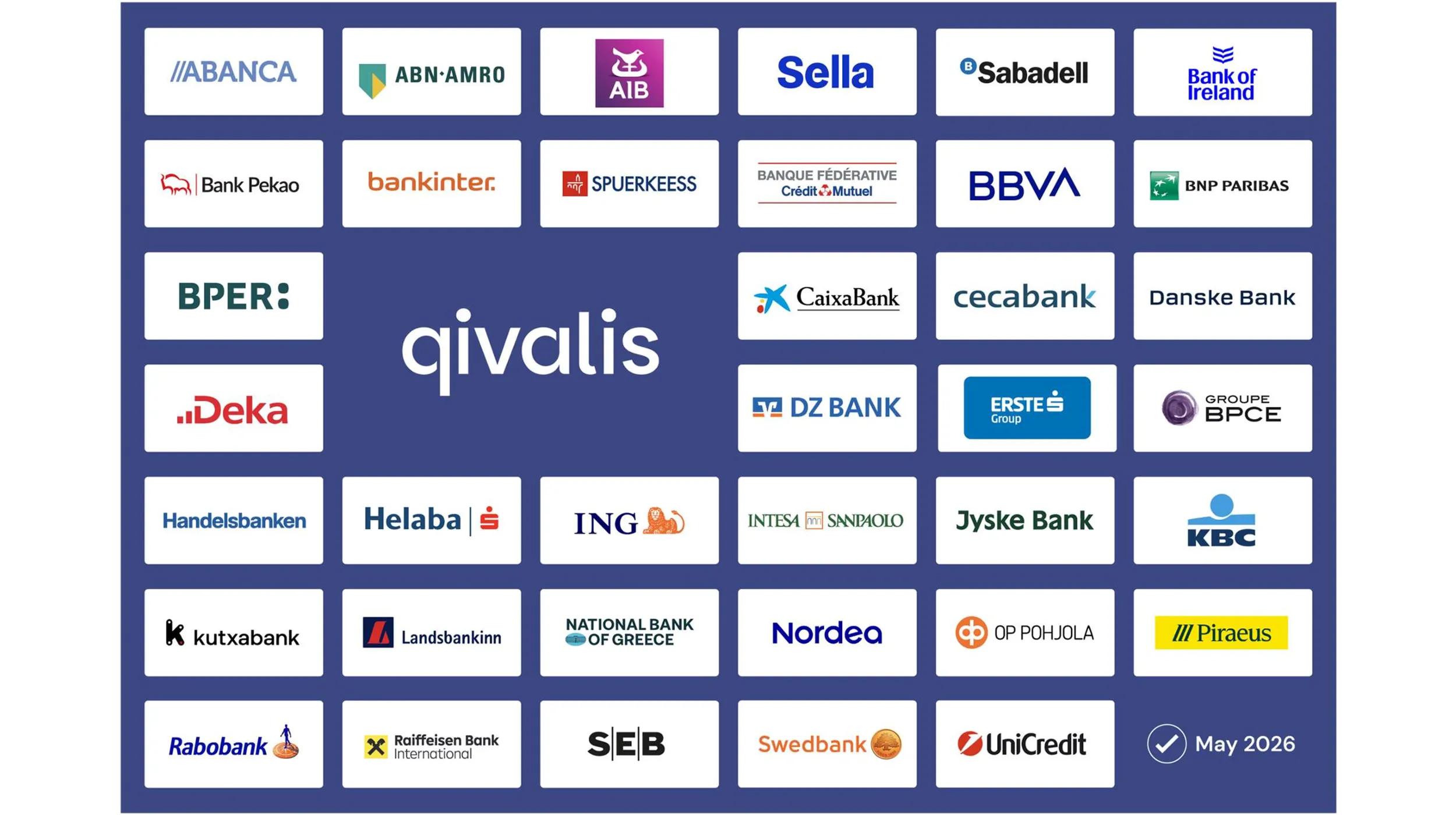
Several developments suggest this transition is already underway. Bank-led tokenised deposit networks provide early examples of how digital money can support treasury activities within existing banking relationships today, while also helping establish the foundations for broader interoperability in the future. For example, J.P. Morgan Kinexys and Citi Token Services enable institutional clients to move tokenised deposits on a programmable and near real-time basis within their respective banking networks. Across the industry, a number of banks, including HSBC , Standard Chartered and UBS , have announced tokenised banking, digital-cash or tokenized deposit initiatives. While the scope and maturity of these programmes differ, they demonstrate the growing interest in digital forms of commercial bank money and their potential role in future payments, settlemen tand treasury workflows.Stablecoin initiatives are also evolving. For example, Qivalis brings together 37 European banks, including 12 founding members such as ING Bank, to develop a regulated stablecoin to support digital payments and liquidity movement across a broader network of participants. Qivalis forms part of a global trend with financial institutions and regulated market participants evaluating stablecoin-based payment and settlement models. Unlike tokenised deposits, which are typically strongest within a single banking network while broader interbank settlement models continue to evolve, initiatives such as Qivalis seek to explore how digital money can move across institutions in a wider ecosystem, while remaining aligned with emerging regulatory frameworks (see Figure 3).
Figure 3: Regulated digital money | European banks join forces through consortium models.
These initiatives demonstrate that digital money is moving beyond experimentation and into institutional use. They also reflect two distinct approaches: tokenised deposits that to day primarily optimise liquidity and payments within individual banking ecosystems, and stablecoin initiatives that seek to enable value transfer across broader networks of participants.
The winners will be ecosystems that connect assets and liquidity into a single seamless operating model.
At the same time, wholesale CBDC initiatives, including projects in Switzerland and other jurisdictions, are exploring how central bank money could support settlement between financial institutions in tokenised markets, helping to establish the foundations for interoperable and scalable digital financial ecosystems. Importantly, the distinction between stablecoins and tokenised deposits should not be viewed as static. Industry efforts are increasingly focused on enabling tokenised deposits to move across banking networks with the same simplicity and certainty that commercial bank money achieves today. While this objective has not yet been fully realised, progress in interoperability and interbank settlement models continues to accelerate. Whether through tokenised deposits, stablecoins or future interoperability frameworks, large-scale adoption will ultimately depend on trusted settlement arrangements, liquidity management and the ability to operate seamlessly across institutions.
5. Not every payment problem needs solving
For many large corporates, the main payment corridors already work efficiently due to evolving regulations, for example instant payments or ISO 20022 adoption. Stablecoins are therefore unlikely to be adopted simply because they offer ano ther way to make the same payment. Additional competition may improve speed, transparency and pricing, but this alone does not create a sufficiently strong treasury proposition. Inefficiencies remain in certain corridors, currencies and market segments, particularly where multiple intermediaries, time zones or local market constraints are involved. This means that the adoption case should be assessed corridor by corridor rather than through a general claim that cross-border payments are universally slow or expensive. A corporation may consider a stablecoin where it provides a more direct way to move value between participants that do not share the same banking network. For example, a multinational with operations across Europe and Asia may face funding requirements outside over lapping banking operating windows. A stablecoin-based settlement mechanism could allow liquidity to be transferred and made available more rapidly without waiting for traditional banking cut-offtimes, provided the relevant regulatory and risk management requirements are met. In this context, the value proposition is not limited to the cost of the individual payment. It may also include greater control over when liquidity moves, reduced dependence on operating windows and the ability to use the same digital liquidity within a wider ecosystem. Once liquidity can move across that ecosystem in a digital form, the payment could also be released when, for example, a delivery took place or contractual conditions are fulfilled. The distinctive opportunity is not a mere cross-border payment, but the ability to combine the movement of money with the underlying treasury event or business conditions, making it programmable.
6. The emergence of programmable treasury
The most compelling opportunity is not faster or cheaper payments. After all, money is already digital today. The more pro found development is programmability: the ability for money to move, settle or change purpose automatically when predefined business conditions are met.
Potential applications include:
- Automated collateral and margin management
- Conditional payments released upon delivery or contractual confirmation
- Automated liquidity management triggering funding or cash sweeping
- Synchronized settlement of cash and assets
- Investment of surplus liquidity into approved short-term instruments based on treasury policies.
The real value of digital money is not faster payments, but liquidity that responds to business events.
Consider a commodity trader required to provide collateral against market exposures. Instead of manually moving cash following a margin call, programmable liquidity could automatically mobilise collateral when predefined thresholds are reached, reducing operational effort and improving responsive ness. Similarly, a payment to a supplier could be released automatically once confirmation of delivery is received, linking the movement of liquidity directly to the underlying business event.
In this hybrid model, payments become embedded within treasury workflows. The relevance of this trend is already visible beyond theoretical discussions. Asset managers, banks and treasury software developers are increasingly building infrastructures that combine tokenised assets with programmable forms of cash. As an example, BlackRock tokenised money market fund initiatives demonstrate how tokenised assets and digital forms of cash could increasingly interact within liquidity, collateral and settlement workflows. Similar developments, including the BNY & Goldman Sachs tokenized money market fund solutions, as well as tokenised money market fund offerings such as WisdomTree WTGXX and BNY TKNXX further illustrate the growing convergence of tokenised assets, digital money and market infrastructure. Beyond investment products, tokenisation is also being applied to collateral manage ment infrastructure. In April 2025, DTCC announced a tokenised collateral-management platform focused on improving collateral mobility, liquidity efficiency and operational processes.
This illustrates how tokenised assets and digital money may increasingly operate together within future financial market infrastructure. These developments demonstrate that the industry’s focus is gradually shifting from digitising payments towards digitising liquidity, collateral and settlement processes. These programmable forms of money may ultimately create the greatest value for corporate treasury.
7. Technology is no longer the main barrier
The technology itself is not new. Perhaps the most significant change over the last several years has been regulatory progress. The examples include: In the European Union, the Markets in Crypto Assets regulation MiCA establishes rules for issuers and service providers, including authorisation, supervision, governance, disclosure and holder protection for asset-referenced tokens and e-money tokens.
In the United States, the GENIUS Act became Public Law 119-27 on 18 July 2025 and established a regime for payment stablecoins, including permitted reserves, redemption procedures, reserve reporting and AML and sanctions controls.
In Switzerland, FINMA has provided regulatory guidance on digital assets, including stablecoins, custody, tokenisation and AML requirements, helping to create greater legal certainty for market participants.
Together, these developments are creating a more predictable regulatory framework. While questions remain, the debate has shifted from regulatory viability to integration with existing financial infrastructure.
8. Integration matters more than innovation
The direction of travel is becoming clearer, but large-scale adoption will depend on more than infrastructure. Treasurers already operate complex technology environments consisting of ERP platforms, treasury management systems, payment factories, SWIFT connectivity, host-to-host channels, API and banking portals. Digital money will need to integrate into these environments rather than create parallel ecosystems. J.P. Morgan Kinexys and Citi Token Services demonstrate that programmable commercial bank money can already support treasury activities within one bank’s network. Scaling these benefits seamessly across banking networks and jurisdictions remains a significant challenge, but also a major opportunity as industry initiatives continue to advance interoperability and interbank settlement solutions.
The long-term winners are unlikely to be individual payment networks. They are more likely to be ecosystems that enable seamless visibility, reconciliation, reporting and control across bank accounts, digital wallets, tokenised assets and in vestment products. Questions around interoperability, settlement arrangements, legal certainty, governance and compliance controls would need to mature. Treasurers will ultimately adopt these solutions not because the technology is new, but because they can rely on them with the same confidence as existing treasury infrastructure.
9. The future is a hybrid treasury
Stablecoins and tokenised deposits are unlikely to replace commercial bank money or existing infrastructure.
The critical infrastructure is not the wallet or the bank account, but the layer connecting them.
Instead, corporate treasurers will operate in a hybrid environment in which bank accounts, tokenised deposits, stablecoins, existing payment rails and tokenised investment products coexist.
Different instruments will serve different purposes. For example, a corporate may continue to manage operational cash through traditional bank accounts, use tokenised deposits for intraday liquidity movements within a banking network (and potentially across multiple banking ecosystems as interbank settlement frameworks evolve), as well as deploy stablecoins for selected cross-network settlement needs and invest excess liquidity in tokenised money market funds outside traditional market operating hours.
Commercial bank money will remain central to day-to-day liquidity management, funding and established banking relationships.
Tokenised deposits may allow treasury activities to become more programmable within a bank’s network or connected banking ecosystem today, with future interoperability potentially extending these capabilities across multiple banking networks.
Stablecoins may provide an additional settlement instrument in situations where value needs to move across networks, particularly in specific cross-border or digital asset ecosystems.
The treasurer will therefore not simply choose between traditional money and digital money. The decision will depend on the use case, currency corridor, counterparty, timing requirement, liquidity available, and the corporate’s risk and governance framework.
Once infrastracture has evolved, treasury will need a common layer through which it can view, control and move liquidity across bank accounts, wallets, networks and investment products. Without that connectivity, tokenisation risks creating additional pools of fragmented liquidity rather than solving the fragmentation treasury already faces.
10. AI and the future treasury operating model
An additional dimension is beginning to emerge. Artificial intelligence is increasingly supporting forecasting, liquidity analysis and treasury decision-making. Recent analysis by the IMF suggests that agentic AI could increasingly support liquidity management, payment orchestration and treasury decision making, helping organisations automate routine financial processes within defined governance and control frameworks. At the same time, programmable forms of money create the possibility for financial actions to execute automatically once predefined conditions are met. Together, these developments could fundamentally alter treasury operating models.
When AI-driven decisions meet programmable money, treasury shifts from executing transactions to designing rules and controls.
Future treasury teams may spend less time initiating transactions and more time designing rules, controls and policies that govern automated financial processes. Instead of manually executing liquidity decisions, treasury may increasingly supervise systems that intelligently manage routine funding, settlement and liquidity optimisation activities within defined risk limits. Whilst this remains an emerging vision rather than an immediate reality, it helps explain why programmable money attracts interest far beyond payments.
Programmable money becomes significantly more powerful when combined with AI-driven treasury decision making.
11. From experimental to expected
In summary, digital money is unlikely to replace existing treasury infrastructure in the near term. Instead, the more realistic outcome is a gradual transition in which bank accounts, tokenised deposits, stablecoins and tokenised investment products coexist, each serving different treasury needs. The first adoptions are likely to occur where a specific treasury problem exists: a difficult payment corridor, an inefficient liquidity process, a collateral requirement, or the need to mobilise liquidity outside traditional operating windows. Over time, these individual use cases may become connected into broader digital treasury ecosystems. A payment can be linked to the delivery of goods. A treasury policy could automatically move excess liquidity into approved tokenised money market funds at the end of the business day and trigger funding transfers between entities when predefined liquidity thresholds are reached. In this scenario, treasury professionals focus less on transaction execution and more on defining the rules, controls and risk parameters governing liquidity decisions. In that sense, the long-term opportunity is broader than faster or cheaper payments. It is the possibility of a more automated, connected and programmable treasury. Ultimately, the success of programmable liquidity will be determined not by the technology itself, but by its ability to solve real treasury challenges and transform treasury operations.
Authors

Monika Schöning
Lead Digital Money & Assets, ING Wholesale Banking

Natalia Heidendal
Head of Transaction Services Sales, ING Switzerland