

Europe at a crossroads - the fragile future of European growth
Reading time: 4min
3 December 2025
East meets West series: insights for a changing world
Contrasts create uncertainty, but also opportunities. Last year, ING economists from Asia, the US, and Europe came together in Amsterdam to share perspectives on today’s fast-moving global economy. In this series, we unpack key trends and provide practical insights to help businesses navigate volatility, seize opportunities, and find clarity in an uncertain world.
While Europe's economy remains stuck in neutral, European corporations will be facing an uncertain future. The optimism from early 2025, sparked by Germany’s unprecedented investment plans, has since given way to renewed uncertainty and uneven momentum across the continent. To make sense of this turbulent moment, ING’s Carsten Brzeski, Head of Global Macro, and Bert Colijn, Chief Economist Netherlands, offer their assessment of what may come next for a continent facing urgent choices on reform, investment, and strategic autonomy. As Brzeski cautions, “Europe always ends up doing the right thing. What’s unclear is whether this time it will do it soon enough”.
Key take-aways:
- Europe's window of opportunity - public and private investments, structural reforms and, increased strategic autonomy are essential to Europe's long-term competitiveness.
- Uncertainty and disruptions will be a fact of life - scenario planning must become a core capability of European businesses in order to identify risks, assess business impacts and prepare mitigation plans.
Germany’s investment boom: Reality vs Expectation
After years of stagnation since the pandemic, Europe experienced a spark of optimism earlier this year. It came from an unlikely source: Germany decided to abandon its long-held fiscal restraint and commit 1 trillion euros to defence and infrastructure spending over the next ten to twelve years. Corporate Germany pledged an additional 600 billion euros in private investments on the back of this government initiative. Yet that optimism has faded quickly, says Opens in a new tabBrzeski:
Over the summer we've seen the entire mood in the German corporate world turn for the worse.
He identifies two reasons: one psychological, one structural.
How Germany's government undermines confidence
"The government should have sustained the initial optimism with continuous and unified positive messaging. Instead, they have been bickering over issues like the retirement age and the reintroduction of military service." Confidence has been damaged further by the government seemingly resorting to creative accounting that, in Brzeski's words, 15 years ago the Germans would not have allowed the Greeks to do. "What many were afraid of is now happening: the infrastructure fund is not being filled with new money, but with relabelled money from the annual budget"
German bureaucracy as a structural brake
The structural factor at work is Germany's cumbersome federal structure and the "horrific bureaucracy" that governs public spending. "Both prevent any speedy flow of money," Brzeski explains. "A defence company told me that since the government's announcement, they haven't received a single new public order." The positive spin Brzeski is able to put on this is that the disappointment is in the timing, not the substance: "Eventually public money will reach the real economy. That will undoubtedly spur growth, but that probably won't happen before the second half of 2026."
Limited spillovers to the Netherlands
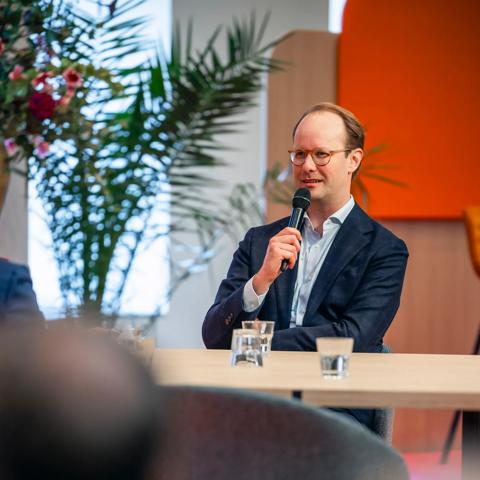
For decades, German growth automatically translated into growth for the Netherlands. That link is weaker today, says Opens in a new tabColijn: "I wouldn't deny that hundreds of billions of extra spending in Germany will have a positive effect on the Dutch economy." His key point, however, is that the Netherlands will benefit less than before. "The Dutch economy is already near capacity, constrained by grid congestion, nitrogen-emission limits, and labour shortages. Until these bottlenecks are resolved, any spillover effect from a German spending spree will be limited. There's hope, however, that a new Dutch government might tackle these issues more effectively than the current one."
Investments must go hand in hand with regulatory stability
Former Dutch central bank president Klaas Knot has called for an 'investment government', and Colijn agrees up to a point: "One only has to look at the issue of grid congestion to see that the Dutch economy is clearly in dire need of improvement. Investments in grid capacity would certainly create room for growth. What we also know for certain is that investments in education and innovation - where the Netherlands consistently fails to achieve its goals - will boost productivity." So the case for increased investments is clear according to Colijn, but he stresses those alone will not suffice: "Without regulatory stability and clarity, such as over nitrogen emissions, investments will be postponed or yield little benefit."
French momentum sputters
Further south, France has turned from one of Europe's economic bright spots into a source of worry. France weathered the energy crisis well and has attracted financial institutions and AI companies. "All of this has been debt-fuelled, but it resulted in fast growth nonetheless," says Brzeski. Now France's political gridlock and deteriorating public finances threaten that momentum. "That is what happens when a country is allowed to run persistent deficits that defy EU fiscal rules. France now faces the same dilemmas as other European countries: how to combine structural reforms and necessary investments with high public debt level and a society that, to put it mildly, does not really embrace austerity or said reforms?" For the time being, Brzeski considers this mainly a domestic and political issue in France. "When you look at interest rates, for example, this is not yet a big European problem. But it is a warning sign to countries like Germany and the Netherlands. If you rely on borrowed money alone for economic growth and fail to enact structural improvements, you will eventually run into trouble."
Southern Europe: outperforming the North

Europe's brightest spots today are even further South. Italy, Greece, Spain, and Portugal have improved their government finances and have done relatively better than the Northern economies. To explain this, Brzeski invokes Johan Cruijff's wisdom that every disadvantage has its advantage:
Having less heavy industry and more tourism have become advantages these days. Obviously, access to funds from the EU's 'Recovery and Resilience Facility' is an advantage too.
Spain in particular deserves credit for its strategic use of EU funds to expand renewable energy capacity. Therein lies a recipe for the future growth of the Eurozone economy, says Brzeski: "Austerity measures combined with structural reforms really pay off, provided - Opens in a new tabBert and I wrote about this - they are complemented by targeted investment transfers."
The glacial pace of EU reforms
The 2024 Draghi report lays out a detailed blueprint for the structural reforms that Europe needs, but has enough progress been made already? Brzeski refers to a recent report that found that only 11 of the 300 or so recommendations in the Draghi report have already been acted upon: "Welcome to Europe: we never make enough progress, and if we do it takes too long. Have we seen steps towards a capital markets union? Have we seen steps towards single European markets for energy, telecommunications, defence, and so on? Have we seen a Eurozone budget with large Eurozone investments? Unfortunately not."
Until these reforms are enacted, the benefits to corporate Europe, from lower borrowing costs to improved access to the broader European market, will remain out of reach.
Geopolitics calls for new urgency
Recent geopolitical events have underscored some of Europe's vulnerabilities and its dependence on global free trade. Chinese export restrictions on Nexperia chips and rare earth metals, in particular, could severely hamper Europe's efforts to create strategic autonomy in two crucial areas: defence and the energy transition. "Europe has long benefited enormously from free trade, but the pandemic should have been a wake-up call," says Brzeski.
Governments and companies realised that the supply chains on which Europe depends must be made more resilient, but too little has happened since. Recent events should renew the urgency to build a more and more integrated and harmonised European economy.
What it means for European business

For corporate Europe, both Colijn and Brzeski see clear lessons. "This might well be the right moment to invest in more robust and localised supply chains," suggests Brzeski. "Some business leaders still think current disruptions are temporary and that we'll soon be back to business-as-usual, just as after the pandemic. That will not happen. We're going through structural changes that will have a permanent effect." Colijn agrees: "The effects of deglobalization and the resulting trade disruptions will indeed be felt for a long time. Companies can no longer stick to a well-defined view of the future. They need to develop various scenarios, including ones that would have seemed quite unrealistic not too long ago. For each of these scenarios, companies should develop a detailed understanding of the risks, assess the potential impact on their businesses, and prepare responses to mitigate them."
A continent at a crossroads
Europe’s economic outlook remains uncertain. As a very mature economy, growth will be modest even in positive scenarios. The continent’s long-term competitiveness hinges on its ability to accelerate reform, coordinate investment, and strengthen strategic autonomy in an increasingly fragmented world. As Brzeski concludes:
Europe always takes a long time to do the right thing, but eventually, it gets there. It still has a window of opportunity to make difficult political decisions. The question is whether this time, ‘eventually’ will be soon enough.
Authors

Carsten Brzeski
Global Head of Macro

Bert Colijn
Chief Economist, Netherlands
Want to explore more?
This article is part of our East meets West series, where ING experts dive deeper into global economic trends and what they mean for your business.
Read more articles in the series:
Conditions for doing business with the U.S. have permanently changed
Understanding the U.S. economic outlook may never have been more critical for European business leaders. For James Knightley, ING's Chief International Economist based in New York, these are therefore paradoxical times. His insights are in higher demand than ever before, yet nobody expects him to get it right all the time.
Conditions for doing business with the U.S. have permanently changed
Europe’s window of opportunity in Asia
Today’s global landscape is especially dynamic. From China’s emerging consumer market to India’s new trade agreements, European firms have a chance to capitalise on sectors that are aligning across continents. ING’s Chief Economists Lynn Song and Deepali Bhargava share their insights on the sectors and strategies that could shape Europe’s advantage.
Europe’s window of opportunity in Asia
Navigating geopolitical and economic turbulence
Global markets, geopolitical shifts, and economic trends rarely move in sync. Every market seems to be pulling in a different direction – and the companies and markets that understand the dynamics and underlying forces hold the advantage.
Navigating geopolitical and economic turbulence