

Global sustainable finance 2026: growth on the horizon
Reading time: 6min
12 August 2026
Resilient issuance keeps the global sustainable debt market on track for growth in 2026, despite geopolitical uncertainty, policy shifts and pockets of saturation. But the ingredients to the ‘sustainable debt cocktail’ are still changing, with some products and regions seeing stronger momentum
Growth set to return despite regional divergence
At the halfway mark of the year, we still Opens in a new tabexpect the global sustainable finance market to return to growth for the full year, surpassing 2025 levels after a modest decline in 2025 from 2024.
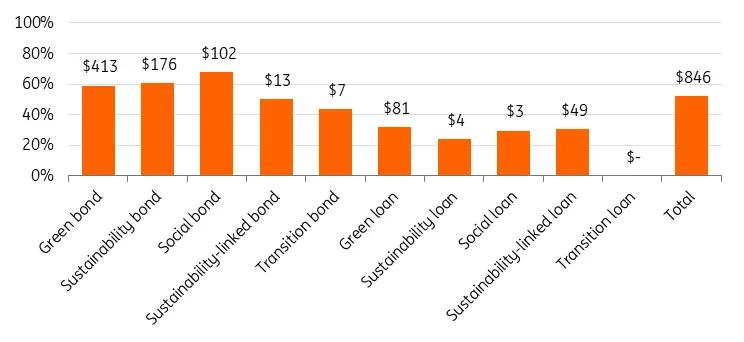
Global sustainable debt issuance (excluding asset-backed securities, or ABS) totalled $846bn in the first half of 2026. Although this is a bit lower than the first-half issuances in 2025, it remains comfortably within the healthy $800bn-900bn range recorded in the first halves since 2022. That shows considerable market resilience, especially given the ongoing Middle East tensions and subdued sustainability policy environment in the US.
Looking at the full year of 2026, we expect resilience to yield growth, with the global sustainable finance market reaching $1,621bn of issuance. This will be driven by many factors:
- Middle East tensions make a stronger case for enhanced energy security, affordability, and industrial competitiveness in Europe through clean energy buildout.
- The rush to build AI-driven data centres – and the growing scrutiny of their sustainability – is expected to drive sustainable debt issuance in the sector globally.
- The consequent need to enhance digital and power infrastructure to support AI development and electrification will spur sustainable financing.
- Many corporates remain committed to decarbonisation and managing climate risk.
- Governments are further leveraging sustainable finance as a tool to fund decarbonisation efforts.
- Regulation and standardisation provide clarity and ease.
Global sustainable debt issuance, historical and forecast
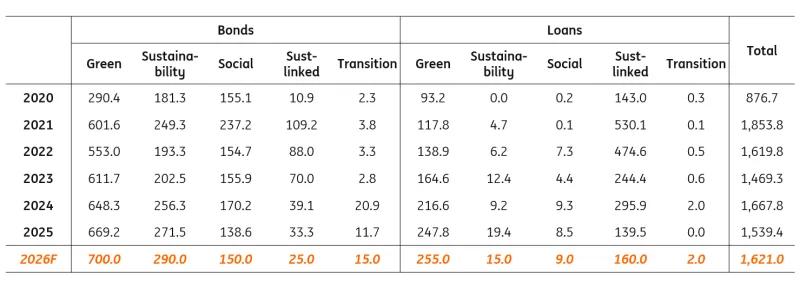
We stand by these forecasts for the year, as we already see most segments beyond the halfway point in terms of reaching these targets. The public market side, in particular, has 55-60% of the forecast already issued.
While the private market side appears to be lagging, we note that there may be some under-reporting within the private market side, and these figures may not reflect full issuance levels.
Global sustainable issuance in the first half of 2026 as a % of full-year forecast
Nevertheless, as noted in our Opens in a new tabmarket outlook in February, our expectations continue to vary across regions.
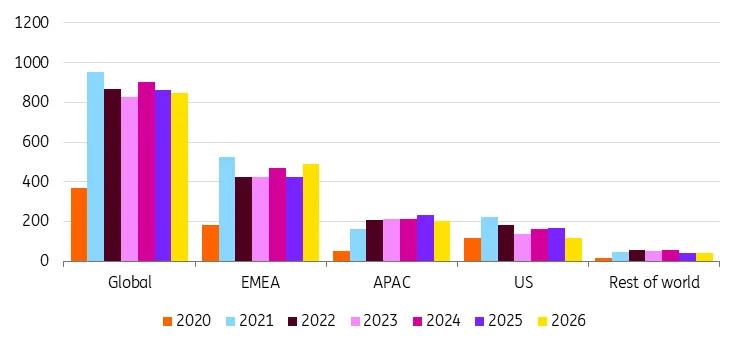
EMEA is leading sustainable debt issuance in 2026. Issuance in both the first and second quarters exceeded 2025 levels, driving a strong first half of the year. Much of this growth came from the public sector, with government agencies, sovereigns, and supranationals issuing a record $245bn in the first half – 50% higher than in 2025. Financial institutions also contributed to the momentum, increasing issuance by 36% year-over-year (YoY).
In APAC, issuance levels have been mostly steady over the past five years, despite first-half 2026 volumes being slightly lower than in 2025. That small dip is mainly due to softer issuance from financial institutions following a record first half in 2025. Even so, APAC is well positioned for growth, with both governments and companies continuing to advance decarbonisation goals through sustainable financing.
In the US, policy uncertainty continues to weigh on sustainable financing. First-half 2026 issuance was about 40% lower than in both 2024 and 2025, although it remained slightly above 2020 levels. Data centres, renewable energy, and related infrastructure have emerged as the engine of sustainable financing. We expect these sectors to maintain momentum through 2026 and 2027. For data centres, however, growing scrutiny of community impacts could lead to more selective, but ultimately higher-quality, sustainable debt issuance.
Sustainable debt issuance by region in the first half of each year
Green bonds and loans are still king
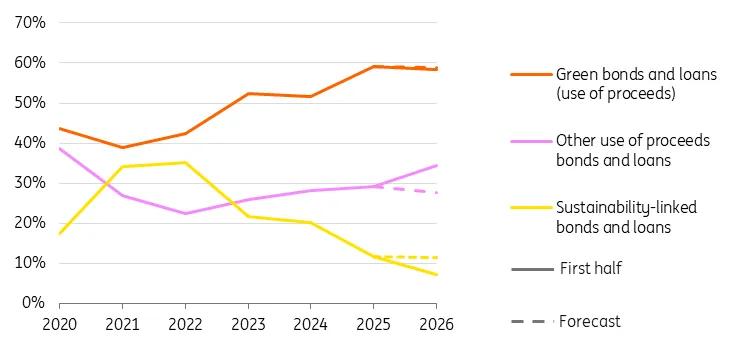
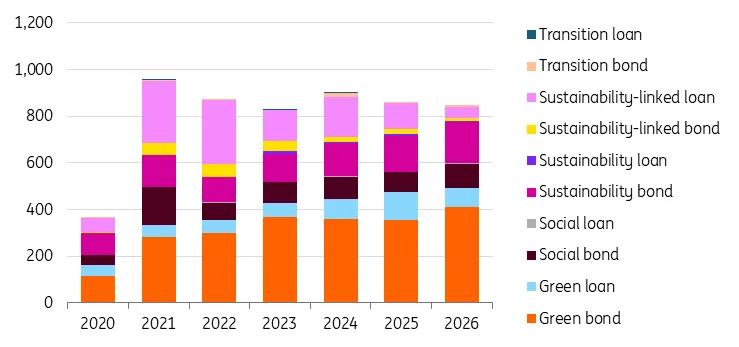
By product type, we expect green bonds and green loans to remain dominant in the global sustainable debt market, together accounting for around 60% of total issuance this year, up from 50% in 2024 and 40% in 2021. This reflects growing market preference for green use-of-proceeds instruments as credible tools for financing environmental projects.
Beyond green instruments, some other use-of-proceeds products, namely social bonds and sustainability bonds, also saw higher first-half issuances YoY, despite accounting for a much smaller market share.
Sustainability-linked bond and loan issuance remained under pressure in the first half of 2026, declining 54% YoY to just over $60bn. Their market share has fallen from 35% in 2022 to just over 10% in 2025, as issuers with green investment plans increasingly opt for green instruments. However, as noted in our previous outlook, sustainability-linked loan volumes are likely understated, as some private transactions may not be captured in sustainable debt databases. Despite accounting for only 7% of issuance in the first half of 2026, we expect the share of sustainability-linked debt to stabilise above 10% for the year.
Share of sustainable debt products in total global issuance
Global sustainable debt issuance by product in the first half of each year
Corporates to remain soft as public issuances pick up
Issuances from non-financial corporates have continued to weaken in 2026. First-half issuance totalled $250bn, the lowest level since 2021. The slowdown was driven largely by weaker-than-expected issuance from European corporates, alongside an anticipated decline in the US amid policy uncertainty.
In Europe, the weakness may reflect a slightly saturated sustainable debt market, mixed with an environment of ease of issuance in general and a lack of economic benefit for going green (i.e. no 'greenium' at this time). This is temporary, as, historically in times of higher volatility within markets, it’s the sustainable bond products that outperform and hold firmer. Naturally, standardisation will continue to keep sustainable issuance effort-free, and the likes of the Green Bond Standard, while not intended to be adopted by all issuers, continue to drive high-quality issuance.
In contrast, issuances from government agencies rose 73% YoY in the first half of 2026. The biggest contributor to that increase is a record $58bn of issuance from German state-owned investment and development bank KfW, with its second-highest first-half issuance being $25bn. The bank has an ambition of investing in competitiveness through environmental action. In APAC, governments in Australia and Mainland China also saw issuance increases.
Global sustainable debt issuance by issuer type in the first half of each year
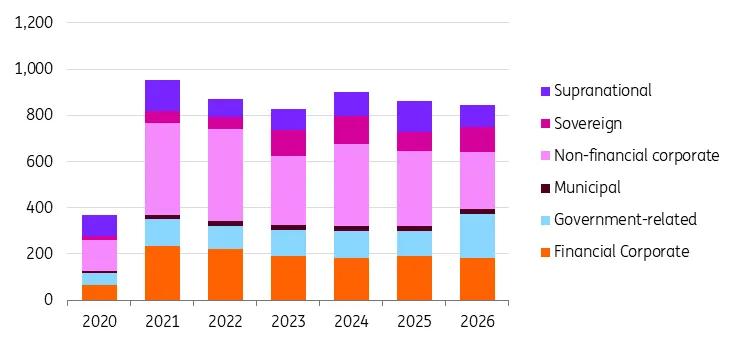
For the rest of 2026, we expect the public sector to be the primary driver of global sustainable debt issuance. Corporate issuance is likely to remain soft and end the year below 2025 levels. However, corporates still have significant sustainable financing needs, as strategic segments such as AI data centres, digitalisation, innovation, and critical infrastructure will increasingly demand energy efficiency and decarbonisation.
There would also be growing regulatory and stakeholder focus on data centre sustainability. The EU is mandating energy reporting and green financing rules for data centres, while actively developing performance standards and efficiency labels. In the US, growing scrutiny of data centres' environmental footprint could lead to a more disciplined approach to sustainable finance.
Conclusion
We expect global sustainable debt issuance to stay relatively strong throughout 2026, supporting our forecast for a return to market growth this year. However, regional, product and issuer dynamics continue to diverge. The sustainable debt cocktail is poised to get bigger, but its ingredients are still evolving.
Content Disclaimer
This publication has been prepared by ING solely for information purposes irrespective of a particular user's means, financial situation or investment objectives. The information does not constitute investment recommendation, and nor is it investment, legal or tax advice or an offer or solicitation to purchase or sell any financial instrument.
Opens in a new tabRead more
Authors

Coco Zhang
ESG Research

Timothy Rahill
Credit Strategist