

AI monthly: 3 key questions we have for AI in 2026
Reading time: 4min
18 February 2026
With rising technological ambition, continued investment in digital infrastructure and new applications within the healthcare sector, AI enters 2026 at full speed. What lies ahead, and where does the momentum lead? Here are some core questions - with potential answers - which could shape the year.

Julian Gieb
Junior Economist, Global Trade
Can data centre building carry construction spending?
The global data centre boom is Opens in a new tabOpens a pdfreshaping the construction sector at a pace and scale never seen before. Large-scale projects now routinely exceed $500 million, and hyperscale campuses can surpass $20 billion in value. This surge has already made data centres one of the fastest‑growing parts of construction pipelines worldwide.
Several constraints are becoming more visible, including vast electrical‑capacity needs, grid-connection bottlenecks, and possible shortages of transformers and GPUs. Power demand, in particular, is emerging as a key limiting factor, with Goldman Sachs analysts estimating Opens in a new tabannual growth rates of 17% through 2028.
Momentum remains geographically uneven, with the US being the unrivalled epicentre of data centre building. But Europe is also accelerating, with construction pipelines up 43% year-on-year, and capacity continues to cluster around major hubs such as London, Dublin, Amsterdam and Frankfurt. Yet congestion in these centres is increasingly pushing operators and hyperscalers to look elsewhere, redirecting build‑outs toward Tier‑2 markets such as Warsaw, Helsinki and the Iberian Peninsula.
Against this backdrop, we expect the EU construction sector Opens in a new tabto return to growth in 2026. Yet, data centre building, while powerful, remains only one segment. High interest rates, labour shortages and persistently elevated material costs still weigh on the broader sector. The current year will show whether data centre momentum can meaningfully counterbalance these headwinds.
When will we see AI revenues surpass investments?
2025 was another year dominated by AI – not just in technology, but across financial markets. According to Morgan Stanley, Opens in a new tabAI stocks have driven roughly three-quarters of S&P 500 returns since the launch of ChatGPT. Beyond markets, AI and the multi-trillion-dollar investments around it have become an anchor of economic growth.
Major big‑tech companies have recently announced a ramp‑up in their capital expenditure plans for 2026 and are now expected to exceed $630 billion this year. By 2025, investors had already put nearly $2 trillion into this technology boom. To put that in perspective, the Apollo programme that ultimately brought humankind to the moon is Opens in a new tabestimated to have cost around $298 billion in today’s dollars.
Big tech capital expenditures continue to climb higher in 2026
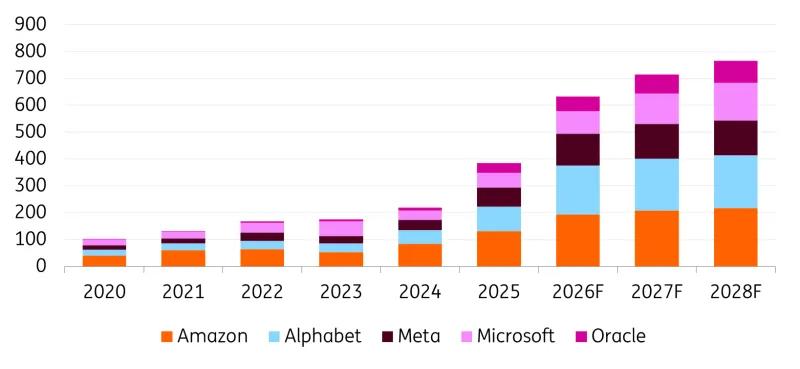
in $ billion
Source: Refinitiv, ING Research
For Nvidia CEO Jensen Huang, demand remains “sky high”, and current investment levels appear both appropriate and sustainable. Yet at the same time, free‑cash‑flow growth is becoming a challenge for the major hyperscalers, who are increasingly Opens in a new tabOpens a pdfturning to debt‑financed capex. This adds vulnerability to the broader financial system should expected returns fail to materialise.
Monetisation is improving, but it's still far from matching the scale of investment. The central uncertainty for 2026 is whether revenues rise fast enough to justify this capital intensity, or whether slowing cash flows and growing reliance on debt signal early limits.
2026 won’t deliver the full answers, but it may offer the first clues.
Can AI lead to efficiency gains in healthcare?
The global healthcare industry faces severe labour shortages, with 4.5 billion people lacking access to essential healthcare services and a projected shortfall of 11 million workers by 2030. As demographic pressure pushes demand higher, AI is increasingly viewed not as a distant vision but as a practical tool to relieve pressure, streamline administrative workloads and free up clinical time.
The rollout of new healthcare‑specific chatbots pushes the debate into new territory. A digital “Dr GPT” could provide initial guidance and help triage symptoms, with early patterns suggesting that younger generations adopt these tools most readily.
At the clinical level, AI is quietly reshaping diagnostic workflows. Systems that analyse X‑rays, CT scans, retinal images or ECGs now support earlier detection of cancers, diabetic retinopathy and heart‑related conditions — in some cases with accuracy on par with that of human specialists. This does not replace clinical judgement, but it does help surface critical findings sooner and free overstretched staff to focus on complex care.
2026 might reveal the first signals of where AI can meaningfully ease healthcare bottlenecks - and where caution must prevail.

Looking for more insights?
Stay up-to-date with our latest articles