
Leadership in banking: Why empathy is a strength
Reading time: 6min
16 March 2026
Careers in banking rarely follow a straight plan. For Mariana Ziemer, too, a career in banking was less the result of a long-term strategy than of a chance encounter. Today, she looks back on almost two decades of experience in the industry and has been part of ING for over a year.
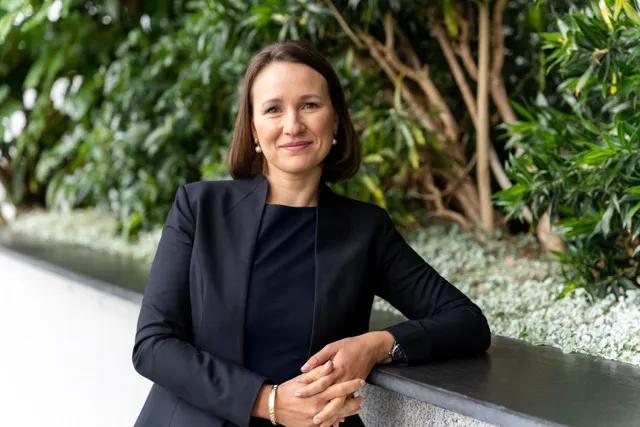
As Head of Client Coverage & Sectors Germany, she is responsible for the strategic and commercial development of seven core industries as well as the holistic support of large German and international corporate clients, including structured corporate finance. The focus is on long-term customer relationships, a deep understanding of the industry and the close integration of sector, product and regional expertise.
In this interview, she explains why she sees conscious steps outside the comfort zone as a prerequisite for personal development and effective leadership – and why empathy is a key leadership strength for her.
How did you get into banking – and how did you get into ING?
My path into banking was not planned. Rather, the trigger was a chance encounter almost 20 years ago with an experienced corporate banker who gave me insights into the diversity of corporate banking. This encounter aroused my curiosity, and so I joined Commerzbank's Mittelstandsbank as a trainee after my studies to get to know the corporate banking business from the ground up.
On my first day at work, however, the merger of Commerzbank and Dresdner Bank was announced. Employees were needed for this major integration project, and so I deviated from my original path early on. I first went to Singapore for almost a year. This was followed by positions in Group Strategy and Sales Management at Mittelstandsbank in Asia, including two years in Shanghai. Actually, I had planned to continue my career in Asia. But it was during this time that I met my current husband, who was living in Frankfurt at the time – and so I returned to Germany.
In Frankfurt, I then consciously made up for what I had planned years earlier: to learn corporate banking from scratch – as part of a comprehensive rotation program. There I discovered the true "magic" of a bank: working directly with the client. Since then, I have been fascinated by working with entrepreneurs to develop solutions that support their strategic goals and to accompany customers through different phases over many years. This fascination has not left me ever since.
Almost ten years ago, I took on my first management role in corporate customer sales. In this role, I learned how crucial it is to take people with me, understand different perspectives and create an environment in which achievement can arise. Most recently, I was COO of Mittelstandsbank in the North/West sales region for three years, where I actively implemented the transformation of the corporate client business.
I moved to ING a little more than a year and a half ago – after almost 17 years at Commerzbank. I am a very loyal person, so this step was well considered. I was particularly impressed by ING's successful growth story in Wholesale Banking in Germany. Within around 15 years, ING has developed into the top 10 of the German banking landscape. Becoming part of this development was a decisive factor for me. Culture was just as important: numerous colleagues from my network already worked at ING and reported very positively on their experiences.
Looking back, however, I deliberately moved out of my comfort zone again and again – driven by curiosity, willingness to learn and the desire to continuously develop myself. My origin from Bulgaria and my path to Germany taught me early on to be flexible and to adapt quickly to new situations. This experience still helps me today – especially in an industry that is constantly changing.
Have there been any challenges or hurdles on your career path?
I wouldn't necessarily call it classic hurdles. When I look back, I remember most of all that I was confronted with certain stereotypes at the beginning of my career.
One situation in particular has stuck in my memory: When I became pregnant with our first of two sons, I was asked several times that I would certainly give up my management role. At first, I couldn't understand that.
In Bulgaria – as in many countries of the former Eastern Bloc – equal treatment of women in professional life is strongly anchored. Working mothers, even in responsible roles, were nothing unusual for me. My mother is a veterinarian – and it was not uncommon for rabbits, guinea pigs or cats to lie on my homework table. So I grew up with the fact that family and career are compatible as a matter of course. This experience made it very clear to me how strongly cultural influences and expectations can influence leadership careers.
How did you deal with these stereotypes?
At the beginning, I tried to adapt – also externally. I put my femininity in the background and deliberately dressed more masculine because I thought it was necessary. Over time, however, I realized that this does not correspond to my personality. I have learned to stay true to myself and to shape leadership in such a way that people feel seen and taken seriously.
What cliché would you like to break in banking?
At the beginning of my career, a tough, distant leadership style was often considered the measure of success. Today I am convinced that empathy is a real leadership strength. It makes it possible to understand different perspectives, to take people along and to make better decisions.
Good leadership means providing clear guidance and creating an environment that overcomes silos and enables cross-functional collaboration – so that people can take responsibility and develop their potential. And this is particularly successful when trust, openness and genuine listening are part of the leadership culture.
Do you feel supported by the culture at ING?
Yes, absolutely. What is crucial for me is that I can show myself authentically. ING creates framework conditions in which different realities of life are taken into account and strengths can be consciously brought in. I experience this openness as a great strength.
What advice would you give to people who want to pursue a career in banking?
Three things are important to me:First, formulate your ambitions clearly and talk openly about them. Second, stay flexible – there is no fixed career blueprint, many opportunities arise unexpectedly. Third, invest consciously in relationships. Networks carry over many years.
Especially in times of profound transformation, it helps to know one's own North Star: What do I stand for, what am I burning for? If you have this clear for yourself, you can stay curious, develop further - and stay true to yourself. Every career path is individual.