
Into Banking via a Traineeship: Why There Is No “Right” or “Wrong”
Reading time: 6min
8 May 2026
Career paths in banking rarely follow a fixed plan. Laura’s entry into banking came through a traineeship – a deliberate choice to experience banking from different perspectives. Today, she looks back on her career start and talks about why pressure is often unnecessary and why banking is far more multifaceted than many people think.
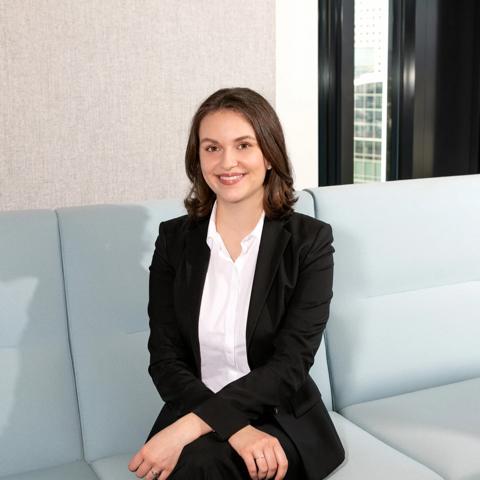
How did you get into banking – and how did you end up at ING?
My path into banking was not clearly planned at all. I completed a bachelor’s degree in Business Administration and then a master’s degree in Finance – so at first glance, quite a classic background. However, my internships were anything but straightforward. I worked in in-house consulting and, during my master’s in Stockholm, more in the startup and holding environment. I actually never did a classic banking internship.
After completing my master’s, the big question arose: which direction do I want to go? And honestly, I kind of “stumbled across” ING and the traineeship. The International Talent Programme just sounded exciting – and at the same time, I had the feeling that banking is much more diverse than it appears during your studies. For me, it was a great opportunity to get to know both the company and the industry better.
I also really liked the application process – especially because it was very personal. An on-site assessment, conversations, time for questions. And to be honest: simply sitting in the cafeteria already gives you a direct sense of what it’s like to work there. During the traineeship, it then became clear that I really enjoy banking.
Have you faced any challenges or obstacles on your career path so far?
My career path isn’t particularly long yet – but one of the biggest challenges for me was the pressure to always make the “right” decision. Especially after graduating, I often felt like I was deciding the next 40 years of my career. And that creates enormous pressure. Looking back, I know that this clear distinction between “right” and “wrong” often doesn’t exist at all.
Do you feel that you are perceived differently as a woman?
I do think that you are confronted with different stereotypes – and not only as a woman. I studied abroad, I’m relatively young, I work in banking – a lot of images come together there. And banking in particular is often associated with certain preconceived ideas.
In everyday work, this becomes especially visible in meetings. I work in project finance, and in many calls I am the only woman or one of just a few. Even though a lot has already improved, differences today are usually not expressed openly, but rather subtly.
You hear statements like: “We’re already equal, aren’t we?” Or assumptions that women are less interested in finance. These comments may seem harmless, but they noticeably shape everyday working life – especially because they are rarely perceived as a problem.
This makes it all the more important that we recognize these patterns, address them openly, and work to change them.
Are there any clichés in banking that you would like to break?
Definitely. Especially the idea that banking is just banking. Many people immediately think of a specific environment or a certain type of person – but the industry is extremely diverse. There are so many different areas and teams.
For example, I only really got to know project finance during the traineeship. It wasn’t present at all at university. I think there’s often simply a lack of points of contact. And then a one-sided image quickly emerges – also reinforced by external factors like dress codes or traditional expectations.
At the same time, banking is becoming increasingly diverse – it’s just not always reflected in public perception yet.
Do you feel supported by ING’s culture?
Yes, absolutely. The topic is addressed very consciously here. The fact that we are having this conversation already shows that open dialogue is encouraged. For me, that was also an important factor in choosing ING.
ING conveys the feeling that there is room for different profiles here. Initiatives like the Young Committee also show that topics such as age stereotypes are taken seriously. It’s about ensuring that younger voices are heard as well.
Overall, I feel that there is strong awareness of these issues – and that active efforts are being made to address them.
Do you have enough female role models around you?
Your interview series itself shows how many strong role models we have. But in everyday work, you do notice that you often still work predominantly with men. The number of women in certain roles is simply still lower.
I would like to see even more women in leadership positions and work with them.
A lot has already changed – but there is definitely still room for improvement.
Looking back, would you do anything differently?
Actually, no. I’ve only been in the job for two and a half years – but I’m very happy with my path. What I would see differently today is that I put too much pressure on myself and overthought things too much.
Especially at the beginning, you have so many options – and decisions are rarely final. You shouldn’t stress yourself too much thinking that one decision closes all other doors. It’s not “fight or flight” – even if it sometimes feels that way.
What advice would you give to your younger self or to other young people?
One important realization for me was how versatile banking actually is. Especially coming straight from university, you often have a very limited view. In reality, there are so many areas that appeal to very different profiles.
And in general: black-and-white thinking doesn’t help. Decisions are rarely final – and there are always opportunities to continue developing or to take new paths.
That’s something I still try to remind myself of today.