
From studying history to Banking: Sigrid's unusual career path
Reading time: 6min
10 March 2026
Careers in banking rarely run in a straight line – and that also applies to Sigrid Seibold. Originally, she wanted to become an archaeologist, but the fall of the Berlin Wall fundamentally changed her path.
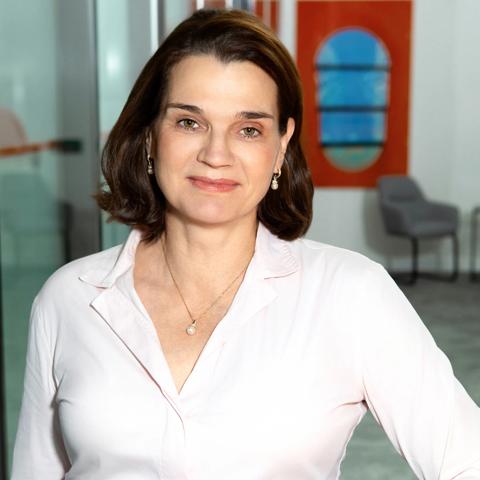
Today, she is Head of Transaction Services at ING Germany. In this role, she is responsible for a central part of the financial infrastructure for corporate clients – from global payments and liquidity management to the further development of digital solutions in corporate banking. At ING, we call Transaction Services the heartbeat of the wholesale bank, because we are part of the operational nervous system of the finance function of many companies.
Prior to joining ING, she worked internationally for many years – first in foreign exchange trading for a few years, later in well-known consultancies with stations in Singapore and New York, where she advised investment banks and hedge funds worldwide on strategy and capital market issues.
We talked to her about her path into banking, formative experiences on her career path and what she would pass on to young talents.
How did you get into banking?
I originally started my path to becoming a banker at Deutsche Bank with a banking apprenticeship. However, the way there was a bit unusual.
I come from the GDR and first studied history – I actually wanted to become an archaeologist. Then the Wall came down and it was unclear how this study would continue. Friends advised me at the time to first do a banking apprenticeship to orient myself in the new world. At that time, Deutsche Bank was setting up additional training programs because it was expected that there would be a lot of demand in the East.
Actually, it was clear to me that the bank branch would not be my long-term path and that I would prefer to finish my history studies. But in my last practical assignment, I ended up in foreign exchange trading. It was fast, international and very dynamic – and that immediately inspired me.
Then I was invited to join the Investment Banking Trainee Program. It was a selective program in which you got to know the entire breadth and depth of the investment bank and which ultimately became the basis for my further career. The bank invested a lot in me at the time – including intensive English courses, behause I spoke Russian fluently, but only school English. I am grateful to the bank for that to this day.
How did you come to ING?
I have worked for many years in international management consultancies, especially in the capital markets sector, advising financial institutions worldwide on strategy, operating model, technology and transformation issues – including in Singapore and New York.
The move to ING was rather unexpected. Personal reasons played a role because I wanted to spend more time in Germany again. At the same time, the structure of my employer at the time had changed and I decided to leave the company. That was a difficult phase for me personally, because I had usually been approached for new roles before – and suddenly had to write a CV for the first time again.
Contact with ING came about through a former colleague. Actually, at first I thought that I wasn't suitable for the role – I couldn't meet some of the requirements from my point of view. But I found the role with the focus on growth and transformation very exciting, so I got curious about the conversation.
Within a short time I had an offer. I found it remarkable that ING hired me, even though I didn't meet every point of the job description. For me, this shows an entrepreneurial culture in which not only the perfect CV is looked at, but also the potential of a person.
What has been one of the biggest challenges on your career path?
One challenge was certainly to reconcile two international careers and family. My husband and I both had very demanding jobs.
He went to Singapore because of my career. Later, I moved to New York for his. And in the meantime, we raised three children together – which brought with it many organizational and personal challenges.
There were moments when I had a guilty conscience, such as when I was on the road a lot while my children were still small. At the same time, I grew up in the GDR with a role model in which working women were completely taken for granted. My mother was a detective chief inspector in the criminal investigation department. That shaped me a lot. And my young adult children today seem to agree with me.
Have you encountered stereotypes in the course of your career?
Yes, of course. Comments are everywhere. For example, I remember being asked, "You're from the East? You don't notice that at all." I tried not to let things like that stop me. If someone thought that certain things should be pigeonholed, my first impulse is rather: Now more than ever.
If you could give your younger self one piece of advice, what would it be?
I would say: "Don't you worry. You're going to be fine."
Worrying is often a waste of time. I would also recommend more self-care to my younger self. Especially in years with a lot of travel, small children and very intensive work, you often don't even notice how exhausted you actually are. And only if you are at peace with yourself can you also be there for others.
What advice would you like to give to young people who want to pursue a career in banking?
Banking is very versatile and interesting – there is a lot to learn. Something I learned far too late is: to actively ask for help. Many people believe they have to do everything on their own. In reality, careers are almost always created together with other people. And often they even like to be part of this path.
… And by the way, archaeology has never completely let go of me – excavation sites are still part of our travel destinations today.